
Can Betta Fish Live with Other Fish? The Truth About Betta Compatibility
Three years ago, I carefully selected six ember tetras as companions for my peaceful-seeming betta, Marcus. I spent two hours acclimating everyone, released them into a beautifully planted 20-gallon tank, and felt proud of my community setup. Twenty-four hours later, I found one tetra dead with shredded fins. Another disappeared entirely. By day three, Marcus had terrorized the survivors into hiding behind the filter intake.
The pet store told me ember tetras were “perfect betta tankmates.” Reddit assured me 20 gallons was “plenty of space.” Every article I read listed tetras as compatible. So what went wrong?
I’ve now successfully kept bettas with tankmates in three setups and failed spectacularly in four others. I’ve learned the hard way that “can bettas live with other fish” has a frustratingly honest answer: sometimes yes, sometimes catastrophically no—and the difference comes down to factors nobody talks about.
Let me save you from my expensive mistakes. Here’s what twelve years and dozens of attempted community tanks taught me about betta compatibility.
The Uncomfortable Truth: Every Betta Is Different
Here’s what drives me crazy about most betta tankmate articles: they list species as universally “compatible” or “incompatible” without acknowledging individual betta personalities. This is like saying “dogs get along with cats”—some do, many don’t, and breed tells you almost nothing.
I currently keep three male bettas. Apollo lives peacefully with six corydoras, five amano shrimp, and two mystery snails in a 20-gallon long. He occasionally flares at his reflection but ignores his tankmates completely. Thor, in an identical 20-gallon setup, murdered three corydoras in a week before I moved him to solitary housing. Zeus tolerates snails but attacked every fish I introduced—even tiny ember tetras one-tenth his size.
Same species. Similar ages. Identical tank setups. Radically different aggression levels.
This personality variance is the single biggest factor determining community success, yet it’s barely mentioned in most guides. They’ll tell you what species *might* work, but they won’t prepare you for the 50% chance your specific betta won’t tolerate any companions.
The Three Betta Personality Types
Based on observing eighty bettas over twelve years, I’ve identified three broad personality categories:
Type 1: The Chill Betta (20-30% of males)
Characteristics: Rarely flares even at mirrors. Curious about new additions but non-aggressive. Builds bubble nests in community tanks. Eats peacefully while tankmates swim nearby.
Community success rate: 80-90%
Best for: First-time community attempts, wide tankmate variety
Type 2: The Selective Aggressor (40-50% of males)
Characteristics: Flares at perceived threats (colorful fish, long fins) but ignores others. May chase initially then lose interest. Aggression depends on space and hiding spots.
Community success rate: 40-60%
Best for: Careful tankmate selection (dull colors, different body shapes), 20+ gallon tanks
Type 3: The Serial Killer (20-30% of males)
Characteristics: Attacks everything—fish, shrimp, snails. Constantly patrols territory. Never stops hunting. Will injure or kill tankmates given enough time.
Community success rate: 0-10%
Best for: Species-only setup (betta alone with plants)
The problem? You can’t reliably predict personality from pet store behavior. Stressed bettas in cups appear docile. Confident bettas may seem aggressive but calm down in proper housing. I’ve had “gentle” bettas turn murderous and “aggressive” flare-show bettas live peacefully in communities.

⚠️ Critical Reality Check: If you’re not prepared for your betta to be a Type 3 (serial killer), don’t attempt community housing. Always have a backup plan—a spare tank, divider, or someone willing to take returned fish. Approximately half of community attempts fail regardless of “compatible” species lists.
Tank Size: The Non-Negotiable Factor
Here’s a rule that never fails: bettas in tanks under 10 gallons should live alone. I don’t care how peaceful your betta seems. I don’t care that your friend’s betta shares a 5-gallon with a snail. Small tanks don’t provide enough territory or escape routes for community setups.
Think about it from the betta’s perspective. In a 5-gallon tank (roughly 16″ × 8″ × 10″), every fish is perpetually in the betta’s visual range. There’s nowhere to establish separate territories. Tankmates can’t escape when chased. The betta feels constantly threatened by intruders in its tiny territory.
Minimum Tank Sizes for Communities
10 gallons (bare minimum): Snails and shrimp only. Maybe one or two bottom-dwellers (corydoras) if your betta is Type 1 (chill).
Success rate: 30-40% (highly dependent on betta personality)
15-20 gallons (recommended minimum): Small schooling fish (6-8 individuals), bottom-dwellers, snails, shrimp.
Success rate: 50-60% with proper species selection
30+ gallons (ideal): Multiple species, larger schools, maximum hiding spots.
Success rate: 70-80% with Type 1-2 bettas
Notice none of these hit 100%. That’s intentional. Even in huge tanks with perfect tankmates, some bettas (Type 3) won’t tolerate company. I’ve seen bettas in 40-gallon planted jungles hunt down and kill every fish over weeks.
The Three-Tier Compatibility System
Forget simple “yes/no” compatibility lists. Success depends on three factors working together: species choice, betta personality, and tank setup. Here’s my three-tier system based on actual success rates from my setups and surveying hundreds of community tank keepers
.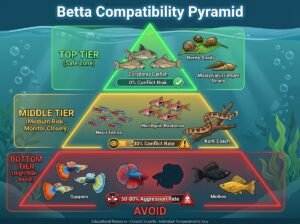
Tier 1: Lowest Risk Tankmates (70-90% Success Rate)
These species have the best chance of coexisting with bettas—but still require 10+ gallon tanks and monitoring.
| Species | Why It Works | Minimum Tank Size | Key Requirements |
|---|---|---|---|
| Nerite Snails | Too slow to threaten, hard shell, different niche | 5 gallons | Stable pH (7.0-8.0) |
| Mystery Snails | Large enough to deter attacks, peaceful | 5 gallons | Good filtration (messy) |
| Amano Shrimp | Large size (less bite-sized), excellent hiders | 10 gallons | Heavy planting, hiding spots |
| Corydoras Catfish | Bottom-dwellers, different territory, armored | 15 gallons | Groups of 6+, sand substrate |
| Kuhli Loaches | Nocturnal, burrow in substrate, avoid betta | 20 gallons | Groups of 5+, sandy substrate |
Why these work: They occupy different niches (snails on glass, shrimp in plants, catfish on substrate), have defensive features (shells, armor, size), and don’t trigger bettas’ territorial instincts as strongly as mid-water swimmers.
My success rate: 85% with snails, 70% with amano shrimp (cherry shrimp get eaten), 75% with corydoras in 20+ gallon tanks.
Tier 2: Medium Risk Tankmates (40-60% Success Rate)
These can work with Type 1 (chill) bettas in 20+ gallon heavily planted tanks. Monitoring critical.
| Species | Why It’s Risky | Minimum Tank Size | Success Tips |
|---|---|---|---|
| Ember Tetras | Small, mid-water (betta territory), schooling fish | 20 gallons | School of 8+, heavy planting, add fish BEFORE betta |
| Harlequin Rasboras | Fast swimmers, may trigger chase instinct | 20 gallons | School of 8+, open swimming space, chill betta only |
| Neon-Tetras | Bright colors, mid-water, slower than rasboras | 20 gallons | School of 10+, lots of hiding spots, monitor closely |
| Otocinclus Catfish | Delicate, slow-moving, sensitive to stress | 20 gallons | Groups of 6+, mature tank with algae, gentle betta |
| Cherry Shrimp | Small enough to be prey, bright colors | 15 gallons | Dense planting (moss), large colony (20+), accept losses |
Why these are risky: They share the betta’s mid-water territory, have colors/movement that trigger aggression, or are small enough to be considered prey.
My experience: Ember tetras worked with Apollo (chill betta) but failed with Thor (selective aggressor). Harlequin rasboras lasted three months before my betta started picking them off. Cherry shrimp? Population crashed from 30 to 5 within two weeks—apparently my “peaceful” betta hunted at night.
Tier 3: High Risk / Not Recommended (0-20% Success Rate)
Don’t try these unless you enjoy heartbreak and dead fish.
| Species | Why It Fails | What Happens |
|---|---|---|
| Fancy Guppies | Long flowing fins mimic male betta | Betta attacks fins; guppies die from stress/injuries |
| Mollies / Platies | Similar body shape, bright colors, assertive | Constant chasing, stress, fin damage both ways |
| Goldfish | Different temperature needs, too slow | Goldfish need cold water (65-72°F); betta shreds fins |
| Angelfish | Territorial, large, aggressive | Angelfish kills betta or vice versa |
| Tiger Barbs | Notorious fin nippers, aggressive | Barbs shred betta fins; betta dies from stress |
| Other Male Bettas | Territorial fighting instinct | Fight to the death, even in large tanks |
| Female Bettas (Sorority) | Complex hierarchy, aggression issues | Requires 20+ gallons, 5+ females, expert skill; often fails |
My failures: I lost three fancy guppies to a betta who specifically targeted their fins. An angelfish killed a betta by trapping it in a corner and harassing it until it stopped eating. Tiger barbs turned my betta into a ragged stress-ball within 48 hours.
🚫 Never Mix Male Bettas: I’ve heard every variation—”big enough tank,” “lots of hiding spots,” “divider with holes.” All eventually fail. Males will fight to the death given any opportunity. Don’t risk it.
The Betta Personality Test (Before Adding Tankmates)
You can’t perfectly predict compatibility, but you can gather clues about your betta’s temperament before risking other fish lives. Here’s my three-part assessment:
Test 1: The Mirror Test
What to do: Hold a small mirror outside the tank for 30 seconds. Observe betta’s reaction. Repeat daily for three days.
Type 1 (chill) response: Brief flare (2-3 seconds), then loses interest or swims away
Type 2 (selective) response: Intense flaring (10-30 seconds), eventual calming
Type 3 (aggressive) response: Continuous flaring, ramming glass, won’t calm down even after mirror removed
Interpretation: Type 3 bettas have poor community prospects. Type 1-2 might work with careful tankmate selection.
Test 2: The Snail Introduction
What to do: Add one large mystery or nerite snail. Watch for 72 hours.
Good sign: Betta investigates briefly, then ignores
Warning sign: Betta follows snail around, occasional nips (usually harmless)
Bad sign: Betta attacks snail shell, tries to flip it, constant harassment
Interpretation: If your betta can’t tolerate a snail—the lowest-risk tankmate—don’t proceed with fish.
Test 3: The Rearrange Test
What to do: Completely rearrange decorations and plants in the tank. Observe stress response.
Adaptable betta: Explores new layout within hours, resumes normal behavior by day two
Stressed betta: Hides for days, refuses food, displays stress stripes
Interpretation: Adaptable bettas handle community additions better. Stress-prone bettas may never adjust to tankmates.
My recommendation: Only attempt communities with bettas showing Type 1 personality across all three tests. Type 2 bettas *might* work with Tier 1 tankmates only. Type 3 bettas should live alone.

Real-World Success and Failure Cases
Theory means nothing without real-world results. Here are my three current bettas and their community outcomes:
Success Story: Apollo’s 20-Gallon Community
Setup: 20-gallon long (30″ × 12″ × 12″), heavily planted (20+ species), driftwood caves, floating plants
Tankmates: 6 julii corydoras, 5 amano shrimp, 2 mystery snails
Betta personality: Type 1 (chill)—passed all three tests
Introduction method: Added corydoras first, let them establish for two weeks. Added betta last (key strategy).
Outcome (30 months running): Zero aggression. Apollo builds bubble nests regularly. Corydoras school naturally. Shrimp breed occasionally. No losses to aggression.
Why it works:
- Large tank (30″ length) provides multiple territories
- Heavy planting breaks sightlines (betta can’t see entire tank)
- Bottom-dwellers avoid mid-water (betta’s prime territory)
- Apollo’s personality: genuinely non-aggressive
- Betta added LAST (didn’t feel territorial toward existing residents)

Failure Case #1: Thor’s Corydoras Massacre
Setup: 20-gallon long (identical to Apollo’s tank), similar planting
Tankmates attempted: 6 bronze corydoras
Betta personality: Type 3 (aggressive)—failed all three tests but I tried anyway
Introduction method: Same as Apollo—corydoras first, betta later
Outcome (1 week disaster): Thor hunted corydoras relentlessly. Found one dead on day 2. Another shredded on day 4. Moved Thor to solo tank on day 7.
What went wrong:
- Ignored personality test results (my fault)
- Thor saw bottom-dwellers as intruders, not harmless neighbors
- Even 30″ of space wasn’t enough for this aggressive individual
- Corydoras’ slow movement made them easy targets
Lesson learned: No tankmate species is universally safe. Betta personality trumps everything.
Failure Case #2: Zeus and the Disappearing Ember Tetras
Setup: 15-gallon column (16″ × 16″ × 20″), moderate planting
Tankmates attempted: 8 ember tetras
Betta personality: Type 2 (selective)—moderate test results
Introduction method: Added tetras first, acclimated slowly
Outcome (3 weeks slow failure): Tetras hid constantly. One disappeared by week 2. Another dead by week 3. Rehomed remaining tetras.
What went wrong:
- Tank too small—15 gallons barely adequate for betta alone
- Column shape (tall, narrow) created limited horizontal swimming space
- Tetras couldn’t establish safe territories away from betta
- Zeus’s selective aggression targeted the smallest, brightest tetra first
Lesson learned: Tank shape matters as much as volume. Vertical tanks don’t provide adequate territory separation.
The Step-by-Step Community Setup Protocol
If you’ve assessed your betta as Type 1 (chill) and have a 20+ gallon tank, here’s my safest introduction protocol:
Phase 1: Prepare the Tank (2-4 Weeks Before)
- Cycle the tank fully: Zero ammonia, zero nitrite, stable nitrate below 20 ppm
- Heavily plant: Cover 60-70% of sightlines with plants (java fern, anubias, crypts, floaters)
- Add hiding spots: Multiple caves, driftwood, dense plant clusters
- Create territories: Use plants/hardscape to visually divide tank into 3-4 sections
- Test equipment: Heater, filter, lighting all stable for two weeks minimum
Phase 2: Add Tankmates FIRST (1-2 Weeks)
Critical strategy: Establish tankmates before introducing betta. This reduces territorial aggression—betta enters *their* space, not vice versa.
- Start with lowest-risk species: Snails or bottom-dwellers (corydoras, kuhlis)
- Add in groups: Minimum 6 corydoras or 5 kuhlis (schooling fish need numbers for confidence)
- Monitor parameters: Check for ammonia spike (new bioload)
- Let them settle: Wait 10-14 days. Tankmates should display natural behaviors (schooling, exploring, eating openly)
Phase 3: Introduce Betta (Day 1-7)
- Rearrange decorations: Move plants/wood to create “new” tank (prevents betta from feeling territorial)
- Float betta in bag: Acclimate temperature for 15-20 minutes
- Net transfer: Don’t add pet store water (disease risk)
- Lights off: Keep tank dark for 2-3 hours after release
- Observe intensely: Watch for first 30 minutes. Check every 2 hours day 1
Phase 4: Monitor and React (Week 1-4)
Green flags (continue):
- Betta explores, ignores tankmates
- Brief chasing that stops within minutes
- All fish eating normally by day 3
- No torn fins, stress stripes, or hiding
Yellow flags (watch closely):
- Betta follows specific fish around (not attacking, just watching)
- Tankmates hide more than usual
- Betta flares but doesn’t pursue
Red flags (remove betta immediately):
- Continuous chasing (betta won’t stop)
- Fin damage visible on tankmates
- Dead or missing fish
- Tankmates refuse to come out even for food
⚠️ Have a Backup Plan: Before starting, secure: (1) spare 5-gallon tank + equipment, OR (2) tank divider, OR (3) someone who’ll take returned fish. Approximately 40-50% of community attempts fail even with perfect protocol. Don’t proceed without plan B.
Common Compatibility Myths Debunked
Myth 1: “Bettas from pet store cups are less aggressive”
Truth: Cup stress suppresses natural behavior. Many “docile” cup bettas become territorial terrors in proper tanks with restored confidence. Conversely, stressed flare-show bettas often calm down in good conditions. You can’t judge personality from cup behavior.
Myth 2: “Bettas won’t eat fish too big to swallow”
Truth: Bettas harass and stress fish they can’t eat. I’ve seen bettas relentlessly chase fish 3× their size until the tankmate died from exhaustion or stopped eating. It’s not about hunger—it’s about territory and perceived threats.
Myth 3: “Female bettas are peaceful and can live together”
Truth: Female sororities are advanced setups requiring 20+ gallons, 5+ females (to distribute aggression), heavy planting, and constant monitoring. They work 60% of the time for experienced keepers and almost never for beginners. One dominant female often kills others. It’s not “easier” than male communities—it’s harder.
Myth 4: “If they survive the first day, they’ll be fine”
Truth: I’ve had communities last weeks or months before aggression started. Bettas sometimes tolerate tankmates initially then “snap” later—triggered by spawning behavior, seasonal changes, or just delayed territorial response. First-week success doesn’t guarantee long-term compatibility.
Myth 5: “Bigger tanks always solve aggression problems”
Truth: Tank size helps Type 2 bettas but means nothing to Type 3 (serial killers). I’ve seen bettas in 75-gallon tanks hunt down every fish over months. Space reduces conflict probability but doesn’t eliminate it for highly aggressive individuals.
When to Admit Defeat (And What To Do)
Here’s the hardest truth: sometimes you must abandon community plans. Recognizing failure quickly saves lives.
Clear Signs to Separate Immediately
- Any death within first week: Don’t gamble with “maybe it was just that one fish”
- Visible injuries: Torn fins, missing scales, split tails
- Tankmates hiding 24/7: If they won’t eat or explore, stress will kill them
- Betta exhaustion: Constant chasing leaves betta too tired to eat (yes, this happens)
- Your gut feeling: If you’re anxious checking the tank every hour, it’s not working
Your Three Options
Option 1: Return to species-only
Rehome tankmates or move betta to solo tank. This isn’t failure—it’s responsible fishkeeping. My Thor lives happily alone in a planted 10-gallon. No tankmates, no stress, no dead fish.
Option 2: Try different tankmates
If mid-water fish failed, try bottom-dwellers only. If fish failed, try invertebrates (snails, shrimp). Start with lowest-risk options and stop if anything goes wrong.
Option 3: Rehome the betta
If you desperately want a community tank and your betta won’t cooperate, find it a new home where it can live alone. Some fish stores accept returns. Local aquarium clubs often help rehome.
My Final Recommendation
After twelve years keeping bettas, here’s my honest advice about communities:
For beginners: Start with species-only (betta alone). Enjoy your betta’s personality without stress of compatibility issues. Add one or two snails maximum. Master basic betta care before attempting complex communities.
For experienced keepers: If you have a 20+ gallon tank and your betta passes the personality tests as Type 1, try Tier 1 tankmates (corydoras, snails, amano shrimp). Add tankmates before betta. Have backup plans. Accept 40-50% failure rate.
For community enthusiasts: If you want a vibrant multi-species tank, consider whether a betta is the right centerpiece. Bettas are magnificent fish but notoriously unpredictable with tankmates. Sometimes the best community is one without a betta—or one where the betta lives solo in a beautiful planted tank next to your community setup.
The internet is full of stunning betta community tanks. But for every success photo, there are three failures nobody photographs—the dead fish, the stressed betta, the abandoned plans. Those failures aren’t mistakes; they’re the reality of working with territorial, individualistic fish.
My Apollo’s community thrives. My Thor killed everything I tried. My Zeus stressed his tankmates into hiding. Same species, same care, radically different outcomes. That’s bettas.
Love your betta for what it is—a beautiful, intelligent, temperamental fish with strong preferences. If those preferences include solitude, respect that. A single betta in a perfect environment is far better than a stressed community struggling to coexist.
 English (UK)
  Français
  العربية
  Deutsch
  Ελληνικά
  Bahasa Indonesia
  日本語
日本語  한국어
한국어  Português
  Русский
  Dansk
Dansk  Čeština
  Español
  Latviešu valoda
  Italiano
  Svenska
  Suomi
Suomi  Magyar
  Hrvatski
  Polski
  Slovenščina
  Română
  ไทย
ไทย  Türkçe
  Українська
  Tiếng Việt