
How Does a Fish Tank Filter Pump Work
Ever wondered what makes that humming device in your aquarium so essential? A fish tank filter pump is the heart of your aquatic ecosystem, working 24/7 to keep water clean, oxygenated, and safe for your fish. Understanding how it works not only helps you maintain a healthy tank but also empowers you to troubleshoot issues and choose the right equipment for your setup.
In this comprehensive guide, we’ll break down the mechanics of aquarium filter pumps, explore the three critical types of filtration, compare different pump systems, and provide expert insights to help you maximize your filter’s performance. Whether you’re a beginner setting up your first tank or an experienced aquarist looking to optimize your system, this guide has everything you need to know.
The Basic Principle: How Filter Pumps Move Water
Understanding the Core Mechanism
At its most fundamental level, a fish tank filter pump operates on a simple principle: it creates water flow by converting electrical energy into kinetic energy. This seemingly simple process involves several sophisticated components working in harmony.
⚙️ The Scientific Explanation
According to Fresh Water Systems: “An electric motor spins the impeller to create kinetic energy. An intake port sucks water in, and the impeller’s kinetic energy transfers to the water. This energy forces the water into the tank, where it circulates into the tank’s filter and eventually makes its way back into the pump.”
The Impeller: The Heart of the Pump
The impeller is the most critical component in any aquarium pump. Think of it as a spinning propeller that lives inside your filter pump. Here’s how it works:
| Component | Function | How It Works |
|---|---|---|
| Electric Motor | Powers the system | Converts electrical energy to rotational motion |
| Impeller Blades | Moves water | Spinning vanes create centrifugal force that pushes water outward |
| Impeller Housing | Contains flow | Directs water through specific pathways |
| Intake Port | Draws water in | Low-pressure zone created by spinning impeller sucks water in |
| Discharge Port | Pushes water out | High-pressure zone forces water through filtration media |
Step-by-Step: Water Flow Through a Filter Pump
- Water enters through the intake tube – The pump’s suction draws dirty aquarium water from the tank.
- Water passes through the impeller – The spinning impeller accelerates the water, creating pressure.
- Water is forced through filter media – High pressure pushes water through mechanical, biological, and/or chemical filtration layers.
- Clean water returns to the tank – Filtered water exits through the output, often via a spray bar or return tube.
- The cycle repeats continuously – This process happens 24/7, circulating your entire tank volume multiple times per hour.
The Three Types of Aquarium Filtration
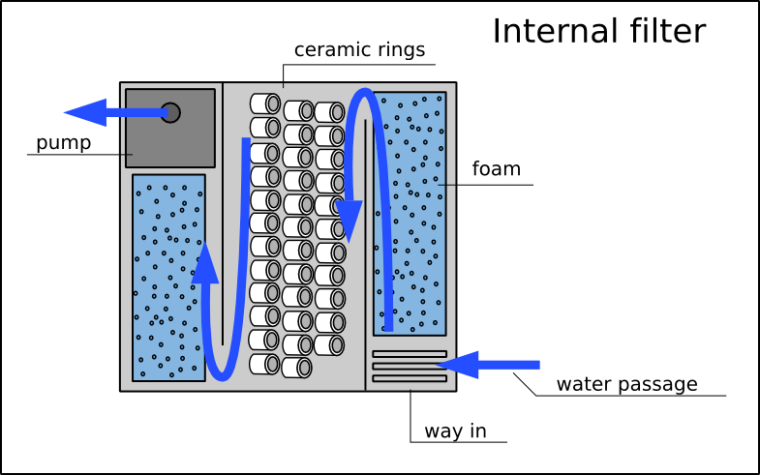
While the pump creates water flow, the filtration media is what actually cleans your water. Every aquarium filter uses one or more of three filtration types:
1. Mechanical Filtration: Physical Debris Removal
🔧 What It Does
Mechanical filtration physically traps and removes solid particles from your aquarium water, including:
- Fish waste (poop)
- Uneaten food particles
- Dead plant matter
- Suspended debris
- Algae particles
| Filter Media Type | Particle Size Removed | Maintenance Frequency | Lifespan |
|---|---|---|---|
| Coarse Sponge/Foam | Large particles (1-5mm) | Rinse weekly | 6-12 months |
| Fine Sponge | Medium particles (0.5-1mm) | Rinse bi-weekly | 6-12 months |
| Filter Floss/Wool | Fine particles (0.1-0.5mm) | Replace weekly | 1-2 weeks |
| Filter Pads | Mixed sizes | Rinse/replace monthly | 1-3 months |
2. Biological Filtration: The Nitrogen Cycle
🦠 What It Does
Biological filtration is the most important type of filtration. It uses beneficial bacteria to convert toxic ammonia (from fish waste) into less harmful substances through the nitrogen cycle:
Ammonia (NH₃) → Nitrite (NO₂) → Nitrate (NO₃)
| Biological Media Type | Surface Area | Best For | Pros & Cons |
|---|---|---|---|
| Ceramic Rings/Balls | High (porous structure) | Large tanks, canister filters | ✅ Lasts years ❌ Expensive initially |
| Bio-Balls | Medium-High | Wet/dry filters, sumps | ✅ Excellent airflow ❌ Needs dry space |
| Bio-Sponge | Medium | All filter types | ✅ Dual purpose (mechanical + biological) ✅ Budget friendly |
| Lava Rock | High (natural pores) | DIY setups, budget builds | ✅ Cheap/free ❌ Heavy, irregular shape |
| Bio-Wheels | Medium | HOB filters only | ✅ Aerobic bacteria thrive ❌ Can get noisy |
3. Chemical Filtration: Removing Dissolved Compounds
🧪 What It Does
Chemical filtration uses reactive media to remove dissolved substances that mechanical and biological filtration cannot handle, including:
- Chlorine and chloramine
- Heavy metals
- Medications (after treatment)
- Tannins (that yellow water color)
- Odors
- Some organic compounds
| Chemical Media | Primary Function | When to Use | Replacement Schedule |
|---|---|---|---|
| Activated Carbon | Removes odors, discoloration, organics | After medications, for crystal clear water | Every 2-4 weeks |
| Zeolite | Removes ammonia (emergency use) | Ammonia spikes, cycling emergencies | When saturated (recharge or replace) |
| Phosphate Removers | Controls algae by removing phosphates | Persistent algae problems | When phosphate levels rise |
| Purigen | Removes organic waste, polishes water | High-end tanks, crystal clarity needed | Every 3-6 months (rechargeable) |
Types of Fish Tank Filter Pumps
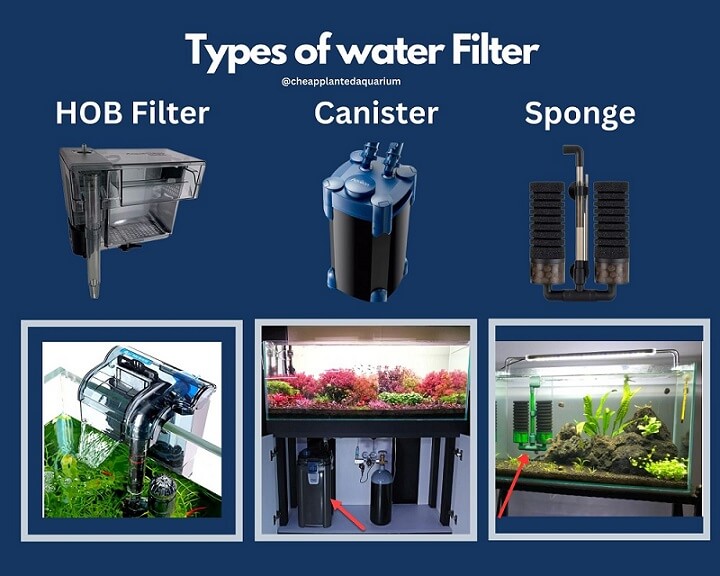
Now that you understand how pumps work and what they filter, let’s compare the different pump types available:
1. Internal Filters (Submersible Pumps)
| Funktion | Beskrivning |
|---|---|
| Location | Completely submerged inside the aquarium |
| Best For | Small tanks (5-20 gallons), quarantine tanks, betta tanks |
| Pros | ✅ Inexpensive ($10-$30) ✅ Easy to install (suction cups) ✅ Quiet operation ✅ All-in-one design ✅ No priming needed |
| Cons | ❌ Takes up tank space ❌ Limited filtration capacity ❌ Difficult to hide in aquascapes ❌ Frequent cleaning required |
| Popular Models | Tetra Whisper Internal (4.2★, 21.8K reviews) – $15.97 |
2. Hang-On-Back (HOB) Filters
| Funktion | Beskrivning |
|---|---|
| Location | Hangs on the back rim of the aquarium |
| Best For | Small to medium tanks (10-75 gallons), beginners, standard setups |
| How It Works | 1. Intake tube sucks water from tank 2. Water lifts into filter box 3. Passes through media (mechanical → biological → chemical) 4. Returns via waterfall or spray bar |
| Pros | ✅ No tank space used ✅ Easy access for maintenance ✅ Moderate price ($20-$60) ✅ Good for all three filtration types ✅ Creates surface agitation (oxygen exchange) |
| Cons | ❌ Can be noisy (waterfall sound) ❌ Visible equipment ❌ Water evaporation can cause issues ❌ Proprietary cartridges expensive |
| Popular Models | • Tetra Whisper IQ 45 (4.2★, 12.5K reviews) – $37.27 • AquaClear Power Filter (4.6★) – Most recommended |
3. Canister Filters (External Pumps)
| Funktion | Beskrivning |
|---|---|
| Location | External unit placed in cabinet below tank |
| Best For | Large tanks (50-200+ gallons), planted tanks, high bioload tanks |
| How It Works | 1. Intake hose draws water from tank 2. Pump pushes water through multiple media trays 3. Water passes through: mechanical → biological → chemical layers 4. Return hose outputs clean water (often with spray bar) |
| Pros | ✅ Massive filtration capacity ✅ Completely hidden (in cabinet) ✅ Multiple media trays ✅ Very quiet operation ✅ Customizable media setup ✅ Strong water flow |
| Cons | ❌ Expensive ($70-$300+) ❌ Difficult to maintain (heavy when full) ❌ Requires priming ❌ Leak risk if seals fail ❌ Complex setup |
| Popular Models | • 265GPH 3-Stage Canister (4.0★, 712 reviews) – $67.99 • Fluval FX Series (Professional grade) • Eheim Classic (German engineering) |
4. Sponge Filters (Air-Driven)
| Funktion | Beskrivning |
|---|---|
| Location | Inside tank, powered by external air pump |
| Best For | Fry tanks, hospital tanks, shrimp tanks, small community tanks |
| How It Works | 1. Air pump sends air through tube 2. Rising bubbles create suction 3. Water is pulled through sponge 4. Sponge provides mechanical + biological filtration |
| Pros | ✅ Extremely cheap ($5-$15) ✅ Gentle flow (won’t suck up fry) ✅ Excellent biological filtration ✅ Nearly impossible to break ✅ Easy to maintain (squeeze sponge) ✅ Adds oxygen |
| Cons | ❌ Ugly (hard to hide) ❌ Limited mechanical filtration ❌ Low flow rate ❌ Air pump can be noisy ❌ Not suitable for large tanks alone |
5. Undergravel Filters
| Funktion | Beskrivning |
|---|---|
| Location | Plastic plate installed under substrate |
| Best For | Simple fish-only tanks (mostly obsolete) |
| How It Works | 1. Uplift tubes create water flow 2. Water is pulled down through gravel 3. Gravel acts as biological filter media 4. Water returns through uplift tubes |
| Pros | ✅ Invisible system ✅ Entire gravel bed is filter media ✅ Inexpensive |
| Cons | ❌ Mostly obsolete technology ❌ Can’t use with sand substrate ❌ Incompatible with planted tanks ❌ Nearly impossible to clean ❌ Creates dead zones ❌ Better alternatives exist |
Filter Type Comparison: Which One Should You Choose?
| Filter Type | Tank Size | Price Range | Maintenance | Filtration Quality | Best Use Case |
|---|---|---|---|---|---|
| Sponge Filter | 5-20 gal | $5-$15 | Very Easy | ⭐⭐⭐ (Biological focus) | Shrimp, fry, hospital tanks |
| Internal Filter | 5-20 gal | $10-$30 | Easy | ⭐⭐⭐ (All-purpose) | Beginner small tanks |
| HOB Filter | 10-75 gal | $20-$60 | Easy | ⭐⭐⭐⭐ (Well-rounded) | Most home aquariums |
| Canister Filter | 50-200+ gal | $70-$300 | Moderate | ⭐⭐⭐⭐⭐ (Professional) | Large tanks, planted tanks |
| Undergravel | 10-40 gal | $15-$35 | Difficult | ⭐⭐ (Obsolete) | Avoid – outdated technology |
Filter Pump Maintenance: Keeping Your System Running Smoothly
Common Maintenance Tasks
| Task | Frequency | How To Do It | Why It Matters |
|---|---|---|---|
| Rinse Mechanical Media | Weekly | Squeeze sponges in old tank water during water change | Prevents clogging, maintains flow rate |
| Check Flow Rate | Weekly | Observe output strength, should be consistent | Weak flow = clogged media or impeller issues |
| Clean Impeller | Monthly | Remove impeller, clean with soft brush, remove debris | Prevents noise, maintains pump efficiency |
| Replace Chemical Media | 2-4 weeks | Remove saturated carbon/zeolite, replace with fresh | Saturated media becomes ineffective |
| Deep Clean Filter | Every 3 months | Disassemble entire filter, clean all parts (NOT bio-media) | Removes buildup, extends equipment life |
Troubleshooting Common Filter Pump Problems
| Problem | Likely Cause | Solution |
|---|---|---|
| No water flow | Impeller stuck or broken | Clean impeller, check for damage, replace if broken |
| Weak flow | Clogged filter media | Rinse/replace mechanical media, check intake tube |
| Loud rattling noise | Dirty/damaged impeller, low water level | Clean impeller shaft, check water level, replace worn parts |
| Water overflow | Severe clog in media or output | Clean all filter components, check output path |
| Filter won’t start after cleaning | Needs priming (canister filters) | Fill canister with water, ensure no air locks |
| Cloudy water persists | Insufficient mechanical filtration | Add fine filter floss, increase flow rate, check bioload |
How to Choose the Right Filter Pump for Your Tank
Step 1: Calculate Required Flow Rate
📐 The Formula
Minimum GPH = Tank Gallons × 4
Ideal GPH = Tank Gallons × 5-6
Example: For a 30-gallon tank:
Minimum: 30 × 4 = 120 GPH
Ideal: 30 × 5 = 150 GPH
| Tank Size | Minimum Flow Rate | Recommended Flow Rate | Suggested Filter |
|---|---|---|---|
| 5-10 gallons | 20-40 GPH | 25-60 GPH | Internal filter or small sponge filter |
| 20-30 gallons | 80-120 GPH | 100-180 GPH | HOB filter or canister |
| 40-55 gallons | 160-220 GPH | 200-330 GPH | HOB filter or canister |
| 75-100 gallons | 300-400 GPH | 375-600 GPH | Canister filter (single or dual) |
| 125+ gallons | 500+ GPH | 625+ GPH | Multiple canisters or sump system |
Step 2: Consider Your Bioload
| Bioload Level | Beskrivning | Flow Rate Adjustment |
|---|---|---|
| Light | Few small fish, many plants, minimal feeding | Standard 4x turnover is sufficient |
| Moderate | Average stocking, some plants, regular feeding | 5-6x turnover recommended |
| Heavy | Many fish, large fish, heavy feeding, minimal plants | 6-8x turnover, consider oversized filter |
| Very Heavy | Goldfish, oscars, cichlids (high waste producers) | 8-10x turnover, multiple filters recommended |
Step 3: Match Filter Type to Tank Type
| Tank Type | Best Filter Choice | Why |
|---|---|---|
| Betta Tank | Sponge filter or adjustable internal filter | Gentle flow needed, bettas dislike strong current |
| Planted Tank | Canister filter with spray bar | Even flow distribution, won’t uproot plants, CO2 efficient |
| Shrimp Tank | Sponge filter with pre-filter | Won’t suck up baby shrimp, provides grazing surface |
| Goldfish Tank | Canister filter or oversized HOB | High waste production requires strong filtration |
| Cichlid Tank | Canister filter with strong flow | High bioload, many species appreciate current |
| Community Tank | HOB filter | Versatile, easy maintenance, suitable for mixed species |
🏆 Top-Rated Filter Pumps on Amazon (2025)
| Product | Type | Tank Size | Price | Rating |
|---|---|---|---|---|
| Tetra Whisper IQ 45 | HOB | Up to 45 gal | $37.27 | 4.2⭐ (12.5K reviews) |
| Tetra Whisper Internal | Internal | 5-10 gal | $15.97 | 4.2⭐ (21.8K reviews) |
| 265GPH Canister Filter | Canister | Up to 75 gal | $67.99 | 4.0⭐ (712 reviews) |
| Tetra Whisper EX 70 | HOB | 45-70 gal | $40.98 | 4.1⭐ (12.5K reviews) |
Vanliga frågor
Conclusion: Mastering Your Filter Pump System
Understanding how your fish tank filter pump works transforms you from a casual hobbyist into a knowledgeable aquarist. You now know that your filter isn’t just a box that “cleans water” – it’s a sophisticated system combining mechanical impeller technology with three types of filtration (mechanical, biological, and chemical) to create a stable, healthy aquatic environment.
🎯 Key Takeaways:
- The impeller is the heart – It converts electrical energy to water movement using centrifugal force
- Biological filtration is critical – Beneficial bacteria process toxic ammonia and nitrite
- Match filter to tank needs – Consider size, bioload, and fish species
- Never turn off your filter – Bacteria need constant oxygen to survive
- Maintenance is key – Regular cleaning prevents problems and extends equipment life
- Overfiltering is better than underfiltering – Within reason, more filtration capacity = more stable tank
Whether you choose a simple sponge filter for your betta tank or a professional canister system for a 200-gallon reef, the principles remain the same: consistent water flow through appropriate media creates the clean, stable environment fish need to thrive.
Remember, your filter pump runs 24/7, processing thousands of gallons of water each day. Invest in quality equipment, maintain it properly, and your fish will reward you with vibrant health, active behavior, and years of enjoyment. Now get out there and put your knowledge to work! 🐠
 English (UK)
  Français
  العربية
  Deutsch
  Ελληνικά
  Bahasa Indonesia
  日本語
日本語  한국어
한국어  Português
  Русский
  Dansk
Dansk  Čeština
  Español
  Latviešu valoda
  Italiano
  Svenska
  Suomi
Suomi  Magyar
  Hrvatski
  Polski
  Slovenščina
  Română
  ไทย
ไทย  Türkçe
  Українська
  Tiếng Việt