
How to Cycle a Tank Without Fish
Here’s the truth nobody tells you at the pet store: You can’t just fill a tank with water, dump in some fish, and call it a day. Well, you can, but those fish probably won’t make it through the week. The good news? You don’t need to sacrifice any fish to get your tank ready. Fishless cycling is easier, faster, and way less heartbreaking than watching your first fish struggle in an uncycled tank.
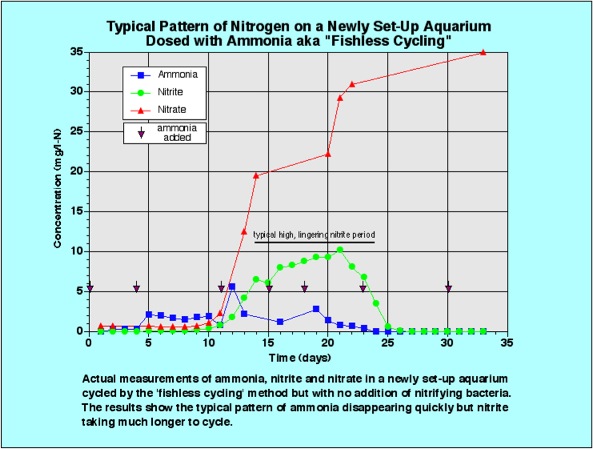
Typical progression of ammonia, nitrite, and nitrate levels during fishless cycling
What Is Fishless Cycling? (And Why You Should Care)
Fishless cycling is the process of establishing beneficial bacteria in your aquarium before adding any fish. Instead of using live fish as ammonia producers (cruel and risky), you add ammonia from another source – usually pure ammonia solution, fish food, or raw shrimp.
Think of it like this: beneficial bacteria are the cleanup crew your tank desperately needs. They eat toxic fish waste (ammonia) and convert it into less harmful stuff. But these bacteria don’t magically appear overnight. They need time to grow and multiply. Fishless cycling gives them that time without putting any fish at risk.
Why Fishless Cycling Beats Fish-In Cycling Every Single Time
Sure, your grandpa probably cycled his tank with fish back in the day. Lots of people did. But just because something was common doesn’t mean it was smart. Here’s why fishless cycling is objectively better:
| Factor | Fishless Cycling ✅ | Fish-In Cycling ❌ |
|---|---|---|
| Fish Mortality | Zero (no fish present) | High risk of death from ammonia poisoning |
| Your Stress Level | Low (check parameters every few days) | High (daily water changes, constant monitoring) |
| Time Required | 4-6 weeks hands-off | 6-8 weeks of daily maintenance |
| Cost | $10-20 for ammonia + test kit | $20-50+ (fish deaths + medications + extra water changes) |
| Ethics | No animals harmed | Fish suffer through toxic conditions |
| End Result | Fully cycled, can add full stock | Partially cycled, add fish slowly |
The Science Behind Fishless Cycling (Without the Boring Stuff)
You don’t need a biology degree to understand this, but you do need to know the basics. Here’s what’s actually happening in your tank during the cycle:
The Three-Stage Process
Stage 1: Ammonia Appears
You add an ammonia source (fish food, pure ammonia, or raw shrimp). Ammonia dissolves in the water. Your test kit shows 2-4 ppm ammonia. Nothing else happens yet because beneficial bacteria haven’t colonized.
Stage 2: Nitrite Shows Up
After 7-14 days, bacteria called Nitrosomonas start multiplying. They eat ammonia and poop out nitrite. Your ammonia drops, but now you have a nitrite spike (which is also toxic). This stage feels like progress, but you’re only halfway done.
Stage 3: Nitrate Arrives (You’re Almost There!)
After another 7-14 days, a second bacteria species called Nitrobacter shows up. They eat nitrite and produce nitrate (which is mostly harmless). Once ammonia and nitrite hit zero while nitrates rise, you’re cycled!
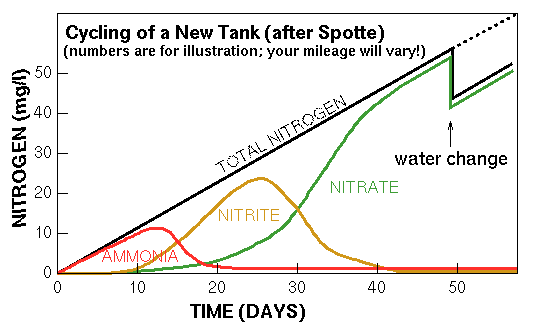
The nitrogen cycle: beneficial bacteria convert toxic compounds into safer ones
What You Actually Need to Cycle Without Fish
Let’s talk gear. You don’t need fancy equipment, but you do need the right stuff. Here’s the complete shopping list:
| Item | Why You Need It | Estimated Cost | Where to Get It |
|---|---|---|---|
| Fully Set Up Tank | Filter, heater, substrate, decorations all running | $50-500+ | Pet store / Online |
| Ammonia Source | Feeds the beneficial bacteria | $5-15 | See options below |
| Water Test Kit | Track ammonia, nitrite, nitrate levels | $20-35 | API Master Test Kit (liquid, not strips) |
| Aquarium Thermometer | Maintain 78-82°F for faster cycling | $5-10 | Pet store / Online |
| Water Conditioner | Remove chlorine/chloramine from tap water | $8-15 | Seachem Prime (best choice) |
| Patience | Cycling takes 4-6 weeks minimum | Free | Inside your brain |
The 4 Best Ammonia Sources for Fishless Cycling (Ranked)
Not all ammonia sources are created equal. Here’s what actually works, ranked from best to worst:
1. Pure Ammonium Chloride (The Gold Standard)
- Precise dosing (you know exactly how much ammonia you’re adding)
- Crystal clear water (no cloudiness or mess)
- Fast and predictable cycling
- No smell or decomposition
- Costs $10-15 for a bottle
- Not available at regular stores (order online)
- Requires some math to dose correctly
Best Products: Dr. Tim’s Ammonium Chloride, Fritz Pro Ammonia

Dr. Tim’s Ammonium Chloride: The most popular choice for fishless cycling
2. Fish Food Method (The Budget Option)
- Super cheap (you probably already have fish food)
- No special products needed
- Works reliably if done right
- Messy (rotting food looks disgusting)
- Can cause bacterial blooms (cloudy water)
- Unpredictable ammonia levels
- Slower than pure ammonia
- Smells bad after a few days
How to Use It: Add a small pinch (enough for 2-3 fish) every 12 hours. Let it rot and decompose.
3. Raw Shrimp Method (The Classic)
- High ammonia output
- Easy to find (any grocery store)
- Works well for larger tanks
- REALLY messy and disgusting
- Smells horrible after 2-3 days
- Causes bacterial blooms
- Unpredictable ammonia release
- Hard to remove when done
How to Use It: Cut 1-2 raw shrimp into pieces and drop them in the tank. Remove after 2 weeks (if you can find them).
4. Household Ammonia (The Risky Choice)
My Recommendation: Unless you’re absolutely desperate, skip household ammonia and use Dr. Tim’s or Fritz Pro instead. It’s worth the $15 to not risk ruining your cycle.
Step-by-Step: How to Cycle Your Tank Without Fish (Pure Ammonia Method)
Alright, let’s get into the actual process. I’m using the pure ammonia method because it’s the most reliable and predictable. Follow these steps exactly:
1 Set Up Your Tank Completely
Before you start cycling, your tank needs to be 100% ready for fish. That means:
- Substrate in place (gravel, sand, or soil)
- Filter installed and running (24/7 – never turn it off!)
- Heater installed and set to 78-82°F
- Decorations, rocks, and driftwood added
- Tank filled with dechlorinated water
- All equipment running for 24 hours (check for leaks)
2 Test Your Starting Parameters
Before adding ammonia, test your water. Record these numbers in a notebook (yes, actually write them down):
- Ammonia: Should be 0 ppm
- Nitrite: Should be 0 ppm
- Nitrate: Should be 0 ppm
- pH: Should be 7.0-8.0 (bacteria grow best in this range)
- Temperature: Should be 78-82°F
3 Add Your First Dose of Ammonia
Now for the moment of truth. Add ammonia until you reach 2-4 ppm. How much to add depends on your tank size:
| Tank Size | Dr. Tim’s Ammonia | Fritz Pro Ammonia | Target Reading |
|---|---|---|---|
| 5 gallons | 20 drops (1 mL) | 15 drops (0.75 mL) | 2-4 ppm |
| 10 gallons | 40 drops (2 mL) | 30 drops (1.5 mL) | 2-4 ppm |
| 20 gallons | 80 drops (4 mL) | 60 drops (3 mL) | 2-4 ppm |
| 40 gallons | 160 drops (8 mL) | 120 drops (6 mL) | 2-4 ppm |
| 55 gallons | 220 drops (11 mL) | 165 drops (8.25 mL) | 2-4 ppm |
Important: Add the ammonia, wait 30 minutes for it to mix, then test. If you’re under 2 ppm, add more. If you’re over 5 ppm, do a 25% water change.
4 Wait and Test (Week 1-2: The Ammonia Phase)
For the first week or two, not much visible happens. But behind the scenes, ammonia-eating bacteria (Nitrosomonas) are slowly multiplying.
Testing Schedule:
- Day 1: Ammonia should be 2-4 ppm
- Day 3: Test ammonia and nitrite (probably both still high)
- Day 5: Test again (ammonia might start dropping slightly)
- Day 7: Test again (look for nitrite appearing!)
5 Add More Ammonia When It Drops Below 1 ppm
Here’s where beginners screw up: they add ammonia once on day 1 and forget about it. Wrong! The bacteria need a constant food source.
The Rule: Whenever ammonia drops below 1 ppm, add another dose to bring it back to 2-3 ppm. This keeps feeding the bacteria so they don’t starve and die off.
6 Watch for the Nitrite Spike (Week 2-4: The Waiting Game)
This is the most frustrating part of cycling. Your nitrite will spike HIGH (often 5+ ppm) and stay there for what feels like forever. This stage typically lasts 1-3 weeks.
What’s Happening: The second bacteria colony (Nitrobacter) is growing, but they multiply slower than the first colony. Be patient – there’s literally nothing you can do to speed this up except maintain proper temperature and pH.
Testing Schedule During Nitrite Phase:
- Test every 2-3 days
- Watch for nitrite starting to drop
- Watch for nitrate starting to appear
- Once nitrite drops below 1 ppm, test daily
7 Perform the Final Test
You think you’re done when ammonia and nitrite hit zero? Not so fast! You need to confirm the cycle is complete with a final challenge test:
- Add a full dose of ammonia (2-4 ppm)
- Wait 24 hours
- Test all parameters
You’re fully cycled if:
- Ammonia = 0 ppm
- Nitrite = 0 ppm
- Nitrate = 20+ ppm
If ammonia or nitrite are still detectable after 24 hours, wait a few more days and test again.
8 Do a Big Water Change and Add Fish
Congrats! Your tank is cycled! Now do this:
- Do a 50% water change to remove excess nitrates
- Add 2-3 small fish (don’t go crazy yet!)
- Test parameters daily for the first week
- Add more fish gradually over the next 2-3 weeks

Typical timeline: ammonia peaks first, then nitrite, finally nitrate accumulates
Complete Timeline: What to Expect Week by Week
Here’s a realistic week-by-week breakdown of the fishless cycling process:
| Week | What’s Happening | Ammonia | Nitrite | Nitrate | What to Do |
|---|---|---|---|---|---|
| Week 1 | Bacteria starting to colonize | 2-4 ppm | 0 ppm | 0 ppm | Test every 2-3 days. Be patient. |
| Week 2 | First bacteria colony growing | 1-3 ppm | 0.5-2 ppm | 0-5 ppm | Add ammonia when it drops below 1 ppm |
| Week 3 | Nitrite spike begins | 0-1 ppm | 2-5+ ppm | 5-20 ppm | Keep adding ammonia. Watch nitrite carefully. |
| Week 4 | Second bacteria colony growing | 0 ppm | 1-5 ppm | 20-40 ppm | Be patient. Nitrite will drop soon. |
| Week 5-6 | Cycle completing | 0 ppm | 0-0.5 ppm | 40-80 ppm | Perform final ammonia test. Prepare for fish! |
The Fish Food Method: Detailed Instructions
Don’t want to buy ammonia? The fish food method works too, but it’s messier and less predictable. Here’s how to do it right:
Step-by-Step Fish Food Cycling
- Day 1: Add a small pinch of fish food (enough for 2-3 small fish). Let it sink to the bottom.
- Day 2-3: Food starts decomposing. Water might get cloudy (bacterial bloom – this is normal).
- Day 4: Test ammonia. You want 2-4 ppm. If it’s too low, add more food. If it’s too high (over 5 ppm), do a water change.
- Every 2-3 days: Add another small pinch of food to maintain ammonia levels.
- Week 2-3: You’ll see nitrite appearing. Reduce food additions to once every 3-4 days.
- Week 4-6: Continue adding food sparingly until ammonia and nitrite hit zero.
Speeding Up the Cycle: What Actually Works
Want to cycle faster? Some methods work, others are scams. Here’s the truth:
| Method | Time Saved | Cost | Does It Work? | Worth It? |
|---|---|---|---|---|
| Raise Temperature to 80-82°F | 5-10 days | Free | ✅ Yes | ✅ Always do this |
| Seeded Filter Media | 2-3 weeks | Free | ✅ Yes | ✅ Best method |
| Bottled Bacteria (Quality Brands) | 1-2 weeks | $15-30 | ✅ Yes | ✅ Worth it |
| Live Plants (Heavy Planting) | 1-2 weeks | $20-50 | ✅ Yes | ✅ Bonus: looks good |
| Used Substrate/Gravel | 1-2 weeks | Free | ✅ Yes | ⚠️ Risk of parasites |
| Cheap Bacteria Supplements | 0 days | $5-10 | ❌ No | ❌ Waste of money |
| “Cycle in 24 Hours” Products | N/A | $10-20 | ❌ No | ❌ Marketing scam |
The Best Bottled Bacteria Products (That Actually Work)
Most bottled bacteria are garbage, but these three actually contain live, viable bacteria:
- Dr. Tim’s One & Only – The gold standard. Contains real Nitrosomonas and Nitrobacter strains. Expensive but works.
- Fritz Turbo Start 700 – Second best. Similar strains to Dr. Tim’s (actually developed by the same scientist). Slightly cheaper.
- Seachem Stability – Different bacterial strains, but still effective. Takes longer than the first two but more widely available.
Troubleshooting: When Things Go Wrong
Problem 1: Cycle Stalled at High Nitrite (The 2-Week Plateau)
Symptoms: Nitrite has been 5+ ppm for over two weeks with no movement. Nitrate isn’t rising.
Causes:
- Nitrite too high (over 5 ppm poisons the bacteria)
- pH dropped below 7.0 (bacteria stop working in acidic water)
- Temperature too low (bacteria slow down under 75°F)
Fixes:
- Do a 50% water change to lower nitrite
- Check pH – add baking soda if it’s below 7.0
- Raise temperature to 80-82°F
- Stop adding ammonia until nitrite drops below 2 ppm
- Wait 3-5 days and test again
Problem 2: Ammonia Won’t Drop Below 4 ppm
Symptoms: Been over a week, ammonia is still sky-high, no nitrite appearing.
Causes:
- Added way too much ammonia initially
- Water temperature too low
- pH too high or too low
- Chlorine/chloramine in the water killed bacteria
Fixes:
- Do a 50% water change (use water conditioner!)
- Verify temperature is 78-82°F
- Check pH is 7.0-8.0
- Add bottled bacteria to jumpstart
- Be patient – sometimes bacteria just take longer to establish
Problem 3: Cloudy White Water (Bacterial Bloom)
Symptoms: Water turned milky white overnight. Can’t see through the tank.
Cause: Heterotrophic bacteria (not the ones you want) are multiplying like crazy, feeding on organic matter.
Fix: DO NOTHING! This is normal during fish food or shrimp cycling. The cloudiness will clear up on its own in 3-7 days. Don’t change water, don’t mess with the filter. Let it resolve naturally.
Problem 4: pH Keeps Crashing Below 7.0
Symptoms: pH starts at 7.5, then drops to 6.5 or lower during cycling.
Cause: The nitrogen cycle produces acid as a byproduct, lowering pH over time.
Fix:
- Do a 50% water change with higher pH water
- Add 1 teaspoon of baking soda per 10 gallons to buffer pH
- Add crushed coral or limestone to the filter (long-term solution)
- Monitor pH weekly and adjust as needed
Problem 5: Cycle Completed, But Ammonia Spiked When I Added Fish
Symptoms: Passed the 24-hour ammonia test, added fish, now ammonia is back.
Cause: You added too many fish at once. The bacterial colony can only handle the bioload it was “trained” on.
Fix:
- Do daily 25% water changes until ammonia drops to zero
- Stop feeding fish for 24-48 hours (less waste = less ammonia)
- Use Seachem Prime daily (detoxifies ammonia temporarily)
- Wait a week before adding more fish
- In the future, add fish more slowly (2-3 per week max)
Cycling With Plants: A Different Approach
Live plants change the game. They absorb ammonia directly, which can significantly speed up cycling or even eliminate the need for traditional cycling altogether. Here’s how plant cycling works:
The Silent Cycle Method (Heavy Planting)
This method is popular in the planted aquarium community. Instead of adding ammonia and waiting, you:
- Set up tank with heavy planting (50-70% of substrate covered)
- Run lights 8-10 hours per day
- Add root tabs and liquid fertilizer
- Wait 2-3 weeks for plants to establish
- Add 2-3 small fish
- Monitor ammonia daily for a week
- If ammonia stays at zero, gradually add more fish
| Best Plants for Cycling | Growth Speed | Ammonia Absorption | Difficulty |
|---|---|---|---|
| Water Wisteria | Very Fast | Very High | Easy |
| Amazon Sword | Fast | High | Easy |
| Hornwort | Very Fast | Very High | Very Easy |
| Water Sprite | Very Fast | Very High | Easy |
| Anubias | Slow | Low | Very Easy |
| Java Fern | Moderate | Moderate | Easy |
Maintaining Your Cycle Long-Term
Congratulations, your tank is cycled! But the cycle doesn’t “end” – it’s an ongoing process that needs maintenance. Here’s how to keep it healthy:
Don’t Kill Your Bacteria (Common Mistakes)
- Never rinse filter media under tap water – Use old tank water instead
- Never replace all filter media at once – Replace 50% max, wait 2 weeks before replacing more
- Never turn off the filter for more than 2 hours – Bacteria need oxygen flow to survive
- Never add medications without research – Some antibiotics kill beneficial bacteria
- Never do 100% water changes – 25-50% max to preserve bacteria
Weekly Maintenance Schedule
| Task | Frequency | Why It Matters |
|---|---|---|
| Water change (25-30%) | Weekly | Remove nitrates and replenish minerals |
| Vacuum substrate | Weekly | Remove waste buildup that creates excess ammonia |
| Test nitrates | Weekly | Ensure they stay below 40 ppm |
| Clean algae from glass | As needed | Improves viewing, doesn’t affect cycle |
| Check equipment | Weekly | Ensure filter and heater work properly |
FAQ: Your Fishless Cycling Questions Answered
Q: Can I really cycle a tank in 24 hours like some products claim?
A: No. It’s physically impossible. Even with the best bottled bacteria and seeded media, you need at least 3-7 days for bacteria to establish. Products claiming “instant cycling” are lying. They might help you add a few fish sooner, but you’ll still see ammonia spikes. Anyone who tells you otherwise is either misinformed or trying to sell you something.
Q: Do I need to add fish food every day during cycling?
A: If using pure ammonia: No, just dose ammonia when it drops below 1 ppm. If using fish food method: Add a small pinch every 2-3 days, not daily. Overfeeding creates too much ammonia.
Q: My cycle has been stuck for 3 weeks. Should I start over?
A: No! Never start over. The bacteria are already established – they just need time to mature. Check pH (should be 7.0+), temperature (78-82°F), and nitrite levels (should be below 5 ppm). Do a 50% water change if nitrite is too high, then be patient. Most “stalled” cycles complete within another week or two.
Q: Can I add snails or shrimp during cycling?
A: Yes, but wait until nitrite drops below 1 ppm. Snails are tougher than shrimp. Mystery snails and nerite snails can handle some nitrite. Shrimp (especially cherry shrimp) are sensitive – wait until ammonia and nitrite are zero before adding them.
Q: I accidentally added way too much ammonia (8+ ppm). Is my cycle ruined?
A: Not ruined, but you need to fix it NOW. Do a 75% water change immediately to bring ammonia down to 3-4 ppm. High ammonia (over 6 ppm) can actually slow bacterial growth. After the water change, continue cycling normally.
Q: Do I need to keep the tank lights on during cycling?
A: It doesn’t matter for the bacteria (they don’t need light). If you have no plants, you can leave lights off to prevent algae. If you have plants, run lights 8-10 hours daily so the plants stay healthy and help absorb ammonia.
Q: How do I know if my used filter media from a friend’s tank is safe?
A: Ask these questions: (1) Is the tank healthy with no current diseases? (2) Have they used copper medications in the past 6 months? (If yes, don’t use it for invertebrates.) (3) Has the filter been running continuously? If yes to 1 and 3, and no to 2, it’s safe. Transfer the media in a bag with tank water and install it within 30 minutes for best results.
Final Thoughts: You’ve Got This
Look, I get it. Cycling sounds complicated and boring. You just want to see some colorful fish swimming around. But here’s the reality: spending 4-6 weeks cycling your tank properly will save you months of frustration, hundreds of dollars in dead fish, and countless sleepless nights wondering why your fish keep dying.
Every experienced fishkeeper went through this process. Every single one. And looking back, they’ll all tell you the same thing: “I wish I’d been more patient and done it right the first time.”
Got questions? Drop them in the comments below. Fellow aquarists (including me) love helping beginners succeed. There’s no such thing as a dumb question when you’re learning.
Now stop reading and go start your cycle! Your future fish are counting on you. 🐠
 English (UK)
  Français
  العربية
  Deutsch
  Ελληνικά
  Bahasa Indonesia
  日本語
日本語  한국어
한국어  Português
  Русский
  Dansk
Dansk  Čeština
  Español
  Latviešu valoda
  Italiano
  Svenska
  Suomi
Suomi  Magyar
  Hrvatski
  Polski
  Slovenščina
  Română
  ไทย
ไทย  Türkçe
  Українська
  Tiếng Việt