
How to Choose the Right Aquarium: 7 Things to Consider Before Setting Up Your Fish Tank
Choosing a new aquarium is one of the most exciting parts of keeping fish. Whether you’re setting up your first freshwater tank or upgrading an existing aquarium, the tank you choose will have a major impact on your fish’s health, maintenance routine, and long-term success.
However, buying an aquarium isn’t simply about choosing a design that looks good in your home. Tank size, fish compatibility, filtration, water quality, and the type of fish you plan to keep should all influence your decision.
Here are seven important things to consider before setting up your next aquarium.
1. Choose the Right Aquarium Size
One of the most common mistakes beginners make is choosing a tank based on appearance rather than the needs of their fish.
A small aquarium might look convenient, but smaller volumes of water can experience faster changes in temperature and water chemistry. They also leave less room for fish to swim and establish territories.
Before purchasing an aquarium, consider:
- The adult size of the fish you want to keep.
- How many fish you plan to introduce.
- Whether your fish need to live in groups.
- Their swimming habits and territorial behavior.
- The space available in your home.
Remember that fish sold in aquarium shops are often juveniles. Some species grow much larger than beginners expect.
It’s also important to distinguish between the advertised tank capacity and the actual amount of water inside. Substrate, rocks, decorations, and equipment all reduce usable water volume.
You can use this Aquarium Size Calculator to estimate your tank’s water capacity in US gallons, UK gallons, and litres using its internal dimensions.
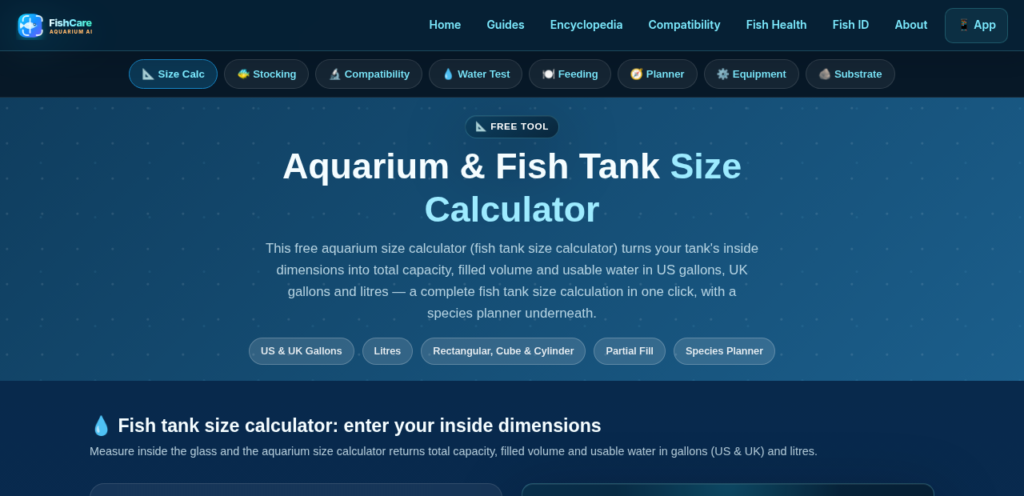
The FishCare AI Aquarium Size Calculator converts inside tank dimensions into US gallons, UK gallons and litres.
2. Understand the Needs of Your Fish Before Buying
Different fish species have very different environmental requirements.
For example, goldfish generally prefer cooler water and produce considerable waste, while tropical species such as bettas and many tetras require warmer temperatures.
Some fish are also more active swimmers and need longer aquariums, while others prefer planted environments with caves and hiding places.
Before selecting your aquarium, research:
- Adult body size.
- Preferred water temperature.
- pH and water hardness requirements.
- Diet and feeding habits.
- Social behavior and minimum group size.
- Preferred swimming space.
A good aquarium setup should be designed around the fish rather than trying to fit fish into an unsuitable tank.
3. Check Fish Compatibility Before Building a Community Tank
A community aquarium can be beautiful, but not every fish can safely live together.
Two species may look peaceful in a shop but behave very differently once they share a limited space.
For example, larger predatory fish may attack smaller tankmates. Some territorial species become aggressive during breeding or when defending their preferred hiding places.
Other fish may have completely different temperature or water chemistry requirements.
When planning a community aquarium, consider:
- Temperament and aggression.
- Differences in adult body size.
- Predator and prey relationships.
- Temperature and pH compatibility.
- Swimming levels and territorial behavior.
Don’t rely on appearance or general labels such as “peaceful community fish.” Individual species requirements matter.
You can compare different species using this free Fish Compatibility Checker. It helps identify potential problems involving aggression, temperature, pH, and size differences before you introduce new fish.
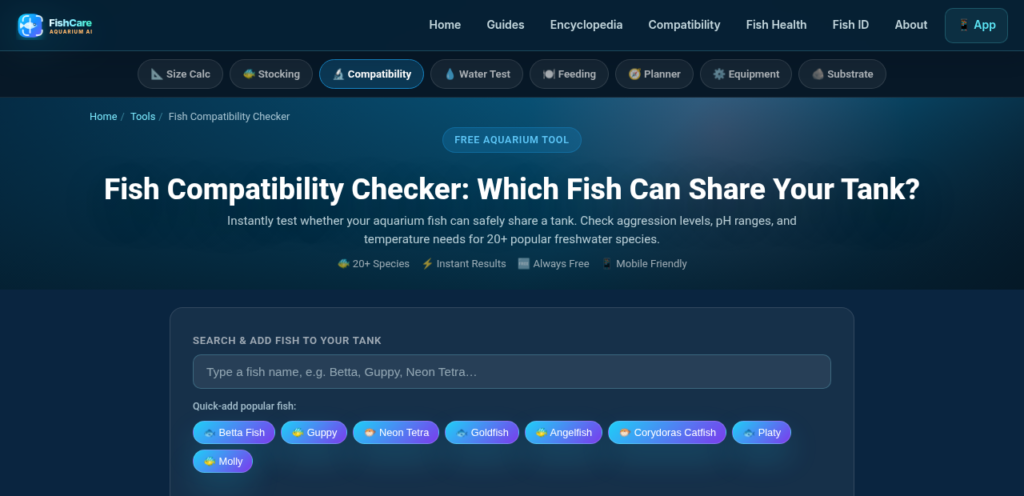
The FishCare AI Fish Compatibility Checker lets you add species and check aggression, pH and temperature fit.
Even when species appear compatible, individual behavior can vary. Always monitor new tankmates and be prepared to separate fish if aggression develops.
4. Pay Attention to Filtration and Water Circulation
A good aquarium needs more than clean-looking water.
Fish produce waste, leftover food breaks down, and organic material accumulates over time. Without proper filtration, harmful substances can build up and affect fish health.
A suitable filtration system should provide three main functions:
- Mechanical filtration:Removes visible particles such as uneaten food and suspended debris.
- Biological filtration:Provides surfaces for beneficial bacteria that help convert toxic ammonia into nitrite and then nitrate.
- Chemical filtration:Uses materials such as activated carbon to remove certain dissolved substances when needed.
The filter should be appropriate for the aquarium’s volume, stocking level, and fish species.
Water circulation is equally important. Some fish prefer gentle water movement, while others naturally live in environments with stronger currents.
The goal is to provide sufficient oxygen exchange and filtration without creating uncomfortable conditions for your fish.
5. Understand Water Quality Before Adding Fish
Clear water doesn’t necessarily mean healthy water.
An aquarium can look perfectly clean while containing dangerous levels of ammonia or nitrite.
Before introducing fish, establish the nitrogen cycle. Beneficial bacteria need time to develop in the filter and other aquarium surfaces.
For a properly cycled aquarium, ammonia and nitrite should both remain at 0 ppm.
Regularly monitor these important water parameters:
- Ammonia:Should remain at 0 ppm.
- Nitrite:Should remain at 0 ppm.
- Nitrate:Should be controlled through maintenance and water changes.
- pH:Should suit the fish species being kept.
- Temperature:Should remain within the appropriate range.
- Water hardness:Should match the needs of your livestock.
If you’re unsure how to interpret your test results, the Aquarium Water Parameter Checker can help you review important readings and identify potential water quality concerns.
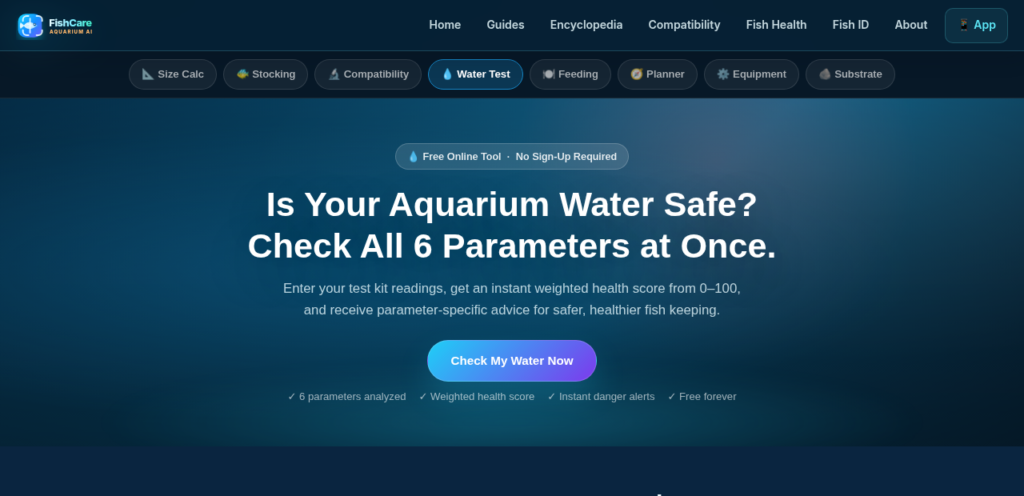
The FishCare AI Water Parameter Checker reviews six test-kit readings at once.
Remember that testing is only one part of aquarium maintenance. Regular water changes, filter care, and observation are also essential.
6. Think About Aquarium Shape and Placement
Aquariums come in many different shapes and designs, including rectangular tanks, cubes, cylindrical aquariums, and rimless glass tanks.
While appearance is important, the shape should also suit the fish and the available space.
A longer aquarium generally provides more horizontal swimming room, which can benefit active swimming species. Taller tanks may suit certain setups, but they don’t necessarily provide the same swimming space as a longer aquarium with an equivalent volume.
Placement is another important consideration. Before installing your aquarium:
- Choose a stable, level stand designed to support the filled tank.
- Make sure the floor can support the combined weight of the aquarium, water, substrate, and equipment.
- Avoid placing the aquarium in direct sunlight, which can encourage algae growth and temperature fluctuations.
- Leave enough space for filter maintenance and water changes.
- Keep electrical equipment and power connections safely arranged.
A well-designed aquarium should be easy to maintain, not just attractive to look at.
7. Plan Your Aquarium Before Purchasing Fish
One final recommendation is to plan your entire aquarium before buying livestock.
It’s tempting to purchase several attractive fish first and figure out the setup afterward. Unfortunately, this often leads to overcrowding, incompatible tankmates, and expensive changes.
A better approach is to work through the following steps:
- Decide which fish species you want to keep.
- Research their adult size and environmental requirements.
- Select an appropriately sized aquarium.
- Choose suitable filtration, heating, and lighting equipment.
- Set up the aquarium and establish the nitrogen cycle.
- Test the water before introducing fish.
- Introduce fish gradually and monitor their behavior.
Planning ahead makes it much easier to build a stable aquarium that meets the needs of its inhabitants.
An Aquarium Planner can also help organize tank size, livestock, equipment, and setup priorities before you start purchasing everything.
The FishCare AI Aquarium Planner builds a setup checklist before you buy fish or equipment.
Итоговые мысли
Choosing the right aquarium is about creating a suitable environment for the fish you want to keep.
A beautiful glass tank is only the starting point. Proper sizing, compatible fish, reliable filtration, stable water conditions, and regular maintenance are what make a successful aquarium in the long run.
Whether you’re a beginner setting up your first freshwater tank or an experienced hobbyist planning a larger aquarium, taking time to research and prepare can prevent many common problems.
The best aquarium isn’t necessarily the biggest or most expensive one. It’s the one designed around the needs of its fish and maintained consistently over time.
 English (UK)
 Français
 العربية
 Deutsch
 Ελληνικά
 Bahasa Indonesia
 日本語
 한국어
 Português
 Русский
 Dansk
 Čeština
 Español
 Latviešu valoda
 Italiano
 Svenska
 Suomi
 Magyar
 Hrvatski
 Polski
 Slovenščina
 Română
 ไทย
 Türkçe
 Українська
 Tiếng Việt